Is Truth or Consequences a Real Town?
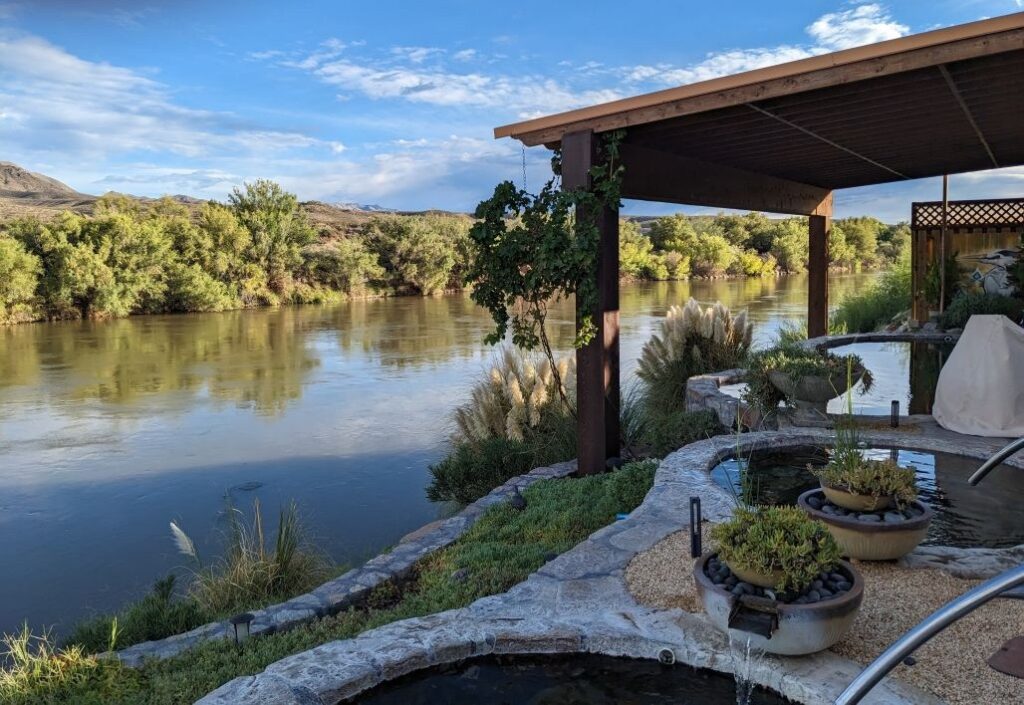
Rio Grande view from Riverbend Hot Springs
Towns are rarely named for game shows, let alone the old radio and television show, Truth or Consequences.
When I dropped by a local bookshop with my latest mystery novel recently, the young clerk took a long look at the title, Murder, Truth or Consequences Style. “Is there really and truly a town named Truth or Consequences?”
I assured her there indeed was, just over the border in New Mexico. Her question surprised me, since the little Southwest town of Truth or Consequences, New Mexico, is less than a day’s drive from Tucson.
On reflection, however, I realized that many mystery authors, myself included, make up things. Especially cozy mystery writers, who create entire communities, replete with aromatic bakeries and bustling bookstores. Sheer fiction, alas.
The town of Hancock, Idaho, the setting for my first two amateur sleuth novels, Mustard’s Last Stand and Foul Wind, was an imaginary amalgamation of several towns in Idaho’s Panhandle.
Truth or Consequences is indeed an odd name for a small town—or a metropolis, for that matter. Many towns changed their names for various reasons, but as far as I know, T or C, as the locals call it, is the only one that did so in response to a challenge from a game show.
In 1950, Ralph Edwards, the host of the popular NBC radio game show Truth or Consequences, announced a contest to celebrate the show’s tenth anniversary. They would showcase any town that chose to change its name to Truth or Consequences on their 10th anniversary program, broadcast from that community—with lots of national publicity. On March 31, 1950, citizens of Hot Springs, NM, voted 1294 – 295 for the name change. The sleepy town needed tourists to survive and voters chose the game show option. The show was broadcast the following day, April 1, 1950. The town celebrates the change each May in an event known as Fiesta, an event Ralph Edwards attended every year for the next fifty.
The name change didn’t go down easily with everyone. After opponents fought the name change through court unsuccessfully, a small faction moved next door in protest and formed the village of Williamsburg (named after their first mayor, Dr. Thomas B. Williams.) In a special election, they later voted to adopt the name Hot Springs (the one discarded by their larger neighbor). However, the name didn’t stick and a year or so later, the town reverted to Williamsburg.
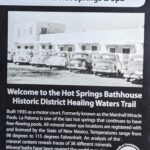
Over the years, voters in Truth or Consequences have twice voted to retain their new, somewhat quirky name, but have established an official hot springs district in the downtown. That district was placed on the National Register of Historic Places in 2004.
Hot Springs earned its original name from the geothermal springs in the floodplain of the Rio Grande, for centuries a gathering spot for the Mimbres and Mogollon people, and later for early ranchers and railroad workers. The first public bathhouse emerged in the late 19th century at John Cross Ranch over the legendary Geronimo Springs. After the completion of the Elephant Butte Dam in the early 1900s, many workers settled in the town and its reputation for healing waters grew. Quite a few of the dam workers’ shacks were moved into town for its new residents and some remain today.
The small Southwest town became known for its healing waters, some of the most heavily mineralized in the United States. Especially notable was its lack of the unpleasant sulfur odor common to many geothermal springs. The town advertised itself as the Health Capital of America in the 1930s and ’40s. In 1939, the Carrie Tingley Hospital for Crippled Children was built to treat children suffering from polio and other orthopedic diseases. The hot springs served as one of the treatments. When medical treatment centers moved to Albuquerque, the facility closed and the services were centralized in Albuquerque.
In 2003, the architecturally significant Pueblo Revival buildings and the site were placed on the state register of Historic Places, and in 2005, on the National Register.
It later became the home of the state’s Veterans’ Home. There is also a small, informative museum and Veterans’ Memorial Park, and a memorial walkway on the site.
Today, the town provides a friendly, relaxing escape, with plenty of beautiful murals, 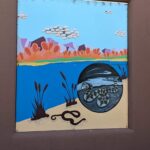 for those who want to bask in the geothermal springs or wander the many art galleries in town.
Or, if you write mysteries, figure out the best place to put a dead body!